


For centuries, the idea of invisibility technology has fascinated us. It has been in myths and science fiction for ages. The dream of being invisible has crossed cultures and time.
Now, this dream is becoming real. Scientists around the world are working on cloaking devices. These devices change how we see light and objects. They show that invisibility is not just a dream.
Stealth technology is not just for the military anymore. Scientists are making materials that hide objects from detection. This makes things invisible to our senses.
This part looks at how ideas turned into real science. We’ll see old myths and new discoveries. These changes change how we see hiding and being seen.
Defining Cloaking Technology and Its Origins
Cloaking technology is a fascinating area of science. It connects ancient myths with modern physics. It aims to hide objects from view by using advanced science.
What Constitutes Cloaking Technology
Cloaking technology is more than just hiding things from sight. It involves changing electromagnetic waves, sound, or heat to avoid detection. There are three main types:
- Optical cloaking: Changes visible light around objects
- Thermal cloaking: Hides heat from infrared detection
- Acoustic cloaking: Redirects sound to evade sonar
Each type needs different materials and methods. But they all aim to make objects invisible to certain technologies.
Historical Perspectives on Invisibility
Invisibility has always fascinated people. It’s found in ancient myths and stories worldwide. Greek tales tell of Hades’ helmet, and Norse myths have magical items for hiding.
Related Posts:
- How Technology Can Help Us in the Future Solving…

- What Are Some Types of Technology A Guide to Tech Categories

- Is Technology Making Life Better or Worse The Great Debate

- What Came First Science or Technology A Historical…

- How Technology Impacts Teaching and Learning Modern…

- How Technology Contributed to Globalization…

Science fiction has also shaped our views on invisibility. Shows like Star Trek introduced advanced cloaking devices. These ideas have sparked real scientific interest.
J.K. Rowling’s Harry Potter series also made invisibility popular. Her magical cloaks mix fantasy with real-world dreams of invisibility. These stories have inspired scientists to work on invisibility technology.
Early Scientific Foundations
The study of invisibility started in the early 20th century. Physicists began exploring how to control light and other waves. Their work laid the foundation for today’s camouflage and stealth tech.
The military drove early research, seeking to gain an edge in spying and defense. The invention of radar-absorbent materials in World War II was a big step forward. It marked the start of modern stealth technology.
Breakthroughs in materials science and wave physics in the mid-20th century made invisibility a real field of study. Scientists learned how to make materials interact with waves in new ways.
Is Cloaking Technology Real: Separating Fact from Fiction
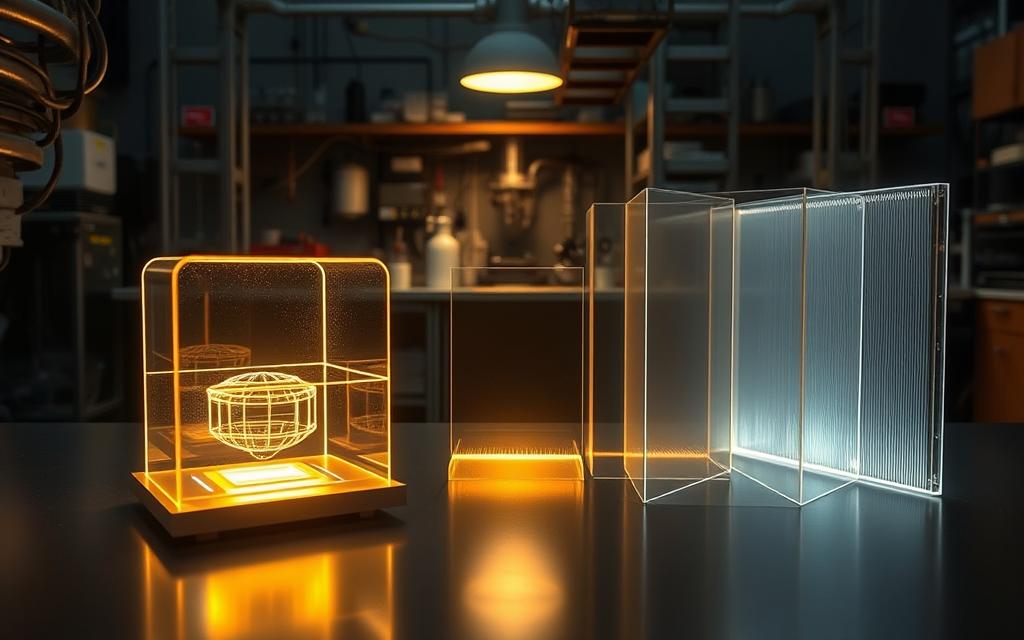
Many people wonder if invisibility technology is real or just a dream from science fiction. While we’re not yet invisible, we’ve made big steps in hiding things. These steps change how we see what’s possible.
Current Capabilities Versus Science Fiction
Science fiction often shows us unrealistic ideas about real cloaking technology. Movies like Predator show things that are impossible. They make invisibility seem easy. On the other hand, Harry Potter’s invisibility cloak makes things disappear completely, no matter the light or view.
But real science is different and just as cool. Scientists have made some amazing things. They work within certain limits:
- Limited spectral ranges (visible light only or infrared only)
- Narrow viewing angles
- Specific background requirements
- Size and scalability restrictions
At the University of Rochester, scientists made a “Rochester Cloak” using four lenses. It bends light around objects. This is a big step towards current invisibility capabilities, but it’s only in the lab and has big limits.
Public Perception Versus Scientific Reality
There’s a big gap between what people think invisibility technology can do and what it really can. Media often makes big breakthroughs seem bigger than they are. Science fiction shows us perfect invisibility without any problems.
“The challenge isn’t making something invisible—it’s making something invisible from all angles, across all wavelengths, while maintaining functionality.”
This science fiction vs reality gap is clear when we look at real military camouflage. Modern stealth tech tries to hide things, not make them invisible.
| Science Fiction Portrayal | Current Reality | Technical Challenges |
|---|---|---|
| Complete visual disappearance | Partial visual distortion | Light phase matching |
| Instant activation | Power-intensive systems | Energy requirements |
| Universal adaptability | Environment-specific systems | Background matching |
| Perfect multi-spectral cloaking | Limited wavelength operation | Material limitations |
Many “invisibility cloak” videos are staged and don’t show real uses. Real progress is slow, solving one problem at a time.
Scientists keep working hard. They use things like metamaterials and adaptive camouflage. These might lead to big steps in hiding technology in the future.
The Physics Behind Invisibility Principles
To understand cloaking technology, we must explore basic physical rules. These rules tell us how objects interact with light and energy. The science of invisibility goes beyond simple camouflage, using complex light manipulation and special materials.
Light Manipulation and Metamaterials
Modern cloaking technology relies on controlling light. Scientists use reflection, refraction, and material engineering to do this. Retro-reflection is a key method, where materials send light back to its source.
Metamaterials are essential in this field. They are made to interact with light in new ways. These materials can bend light around objects, making them invisible.
Creating these materials is a big step forward in optical physics. Scientists keep improving them to make cloaking better and more effective.
Electromagnetic Spectrum Considerations
Cloaking technology varies by wavelength in the electromagnetic spectrum. Hiding visible light is harder than infrared or ultraviolet. Each range needs its own materials and solutions.
Infrared cloaking deals with heat, using materials that manage heat radiation. Microwave and radar cloaking use conductive materials to block radio waves. This shows how complex invisibility systems are.
Modern systems aim to work across many spectrum regions. This is the forefront of electromagnetic cloaking research.
Wave Behaviour and Cloaking
Wave behaviour is key to all cloaking technologies. Light and sound waves can be changed by engineering their paths. This involves managing wave phase, amplitude, and direction with special materials.
Acoustic cloaking works with sound waves, creating silent zones around objects. The maths behind wave manipulation is the same for all types, but the application differs. This knowledge helps scientists create better cloaking systems.
Recent breakthroughs in wave manipulation have opened new possibilities. These advances are expanding what scientists can achieve in concealment technology.
Metamaterials: The Foundation of Modern Cloaking
Today, scientists focus on metamaterials for cloaking. These are made materials that don’t follow the usual rules of light. They are key to making things invisible by controlling light.
Understanding Metamaterial Properties
Metamaterials are made from tiny structures that are smaller than light waves. These tiny patterns let light behave in ways that normal materials can’t.
One cool thing about them is they can bend light in the opposite way. This is because of their special properties.
To make these materials, scientists use tiny metal parts and special materials. These structures can control light waves in ways we never thought possible.
How Metamaterials Bend Light
Transformation optics is the math behind bending light. It tells us how to make materials that can hide objects from view.
Metamaterials use tiny patterns to guide light around hidden objects. This makes the objects invisible without changing the light.
This trick needs very precise control over light. Scientists use special parts that work well with certain light waves.
Current Limitations of Metamaterial Cloaks
Even with big steps forward, there are big challenges. The biggest one is that they only work in a small range of light frequencies.
Creating cloaks that work across many frequencies is hard. It needs complex designs that are hard to make.
Another problem is size. Cloaks need to be much bigger than what they hide. This makes them hard to use in real life.
| Limitation Type | Current Status | Research Challenges | Potential Solutions |
|---|---|---|---|
| Bandwidth Restrictions | Narrow frequency operation | Multi-spectral compatibility | Multi-layer metamaterials |
| Size Constraints | Large cloak-to-object ratio | Scalability issues | Active metamaterial systems |
| Manufacturing Complexity | Laboratory-scale production | Mass production techniques | Nanoprinting technologies |
| Angle Dependency | Limited viewing angles | Omnidirectional performance | Spherical metamaterial designs |
Making metamaterials is also a big problem. It’s expensive and hard to do on a large scale.
Most cloaks only work from certain angles. Scientists are working on making them work from all angles.
Despite these challenges, scientists are making progress. They are getting closer to making cloaking technology that works in real life.
Active Camouflage and Adaptive Systems
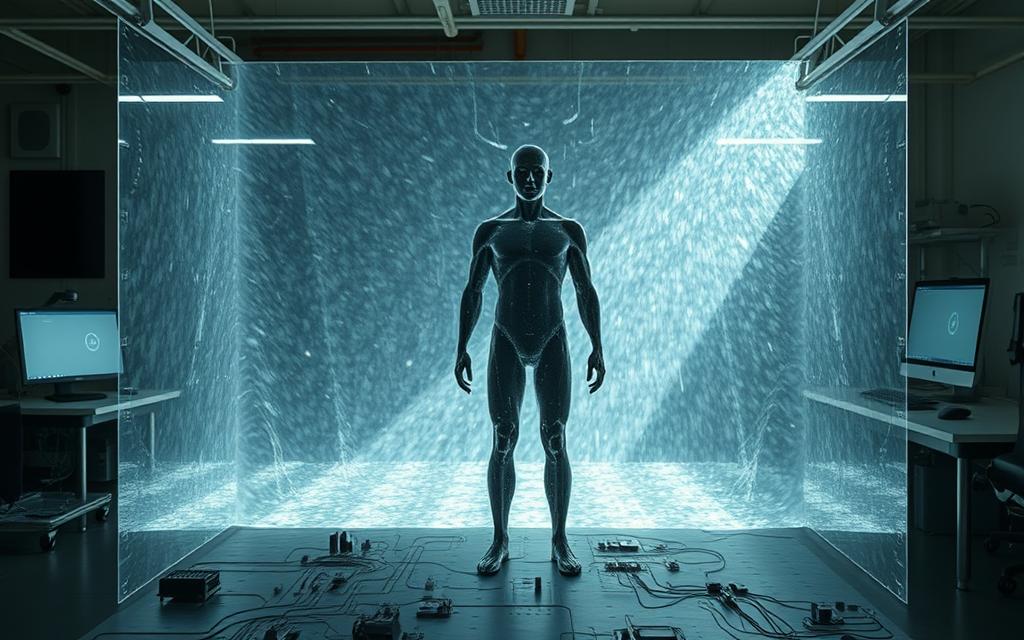
Active camouflage is at the forefront of invisibility technology. It changes with the environment, unlike static materials. This makes it more effective than old methods.
Electro-Optical Camouflage Technologies
Electro-optical systems use sensors and displays for real-time hiding. Cameras capture the background, which is then shown on special surfaces. This makes the object seem invisible by matching its look to the surroundings.
These systems use smart algorithms for complex lighting and movement. Fast processors help them adapt quickly. This is a big step up from old camouflage methods.
Dynamic Colour Matching Systems
Dynamic colour matching is inspired by chameleons. It uses chemical changes to blend in. Chinese researchers have made a system that does this well.
This technology changes colour with light without needing power. It’s a big advantage for some uses.
“The development of self-adaptive photochromic materials represents a paradigm shift in camouflage technology, moving from active electronic systems to passive chemical adaptation.”
Projection-Based Cloaking Approaches
Projection technology uses cameras, computers, and projectors for invisibility. It captures the background and projects it on special materials. This creates a convincing illusion of invisibility.
It works well with moving backgrounds and changing lights. It’s great for military and security needs.
| Technology Type | Adaptation Mechanism | Response Time | Energy Requirements |
|---|---|---|---|
| Electro-Optical Systems | Electronic sensors and processors | Milliseconds | High (continuous power) |
| Dynamic Colour Matching | Chemical structure transformation | Seconds to minutes | Low (light-activated) |
| Projection-Based Systems | External projection equipment | Real-time | Very high (multiple systems) |
Each method has its own benefits. Electro-optical systems are fast but need a lot of power. Dynamic colour matching is passive but slower. Projection technology is impressive but complex.
The future will likely see combinations of these technologies. Researchers aim to improve energy use and speed. These advancements will keep pushing the limits of camouflage.
Military Applications of Cloaking Technology
Defence applications are at the forefront of cloaking technology. These systems offer a strategic edge by making assets harder to spot. They have moved from theory to real-world use.
Stealth Aircraft and Radar Absorption
Stealth aircraft use special designs to hide from radar. Their shapes and angles deflect radar waves. This makes them harder to detect.
Radar absorption materials are key in stealth tech. They turn electromagnetic energy into heat, not reflecting it. This is done with materials like carbon particles or ferrite.
The F-35 Lightning II is a prime example of stealth in action. Its design lets it sneak into defended areas undetected. This is a major success in cloaking technology.
Vehicle and Personnel Camouflage Systems
Ground forces use camouflage systems for vehicles and troops. These systems blend with the surroundings. The British Army has tested systems to make tanks almost invisible.
Current systems include:
- Electro-optical camouflage that adjusts to changing backgrounds
- Thermal signature suppression materials for infantry uniforms
- Multi-spectral concealment systems for command vehicles
There are also experimental systems like projection-based camouflage. These help protect troops on the move or in place. The goal is to make these systems more effective and practical.
Naval Applications and Submarine Technology
Naval vessels, like submarines, use advanced cloaking techniques. These systems are among the most advanced in military use. Submarine stealth combines various methods to avoid detection.
Acoustic cloaking reduces sound signatures with special coatings. These coatings absorb sonar pulses. Advanced propellers also help in reducing sound detectability.
Magnetic signature reduction systems protect against mine detection. Naval camouflage also includes visual deception for surface vessels. These methods make ships harder to spot and target.
Modern submarines use these technologies to stay hidden. This gives them an edge in gathering intelligence and deterrence. They are much harder to detect across different sensors.
Commercial and Civilian Uses of Cloaking Principles
Cloaking technology is not just for the military anymore. It’s now used in many everyday ways. This shows how science can change our lives and the world around us.
Architectural and Design Applications
Architects and designers are using architectural invisibility to create amazing buildings. They use special glass and materials to make buildings seem invisible or transparent from certain angles.
Some cool commercial cloaking ideas in architecture include:
- Facade systems that mirror the sky and surroundings
- Adaptive building materials that change appearance based on lighting conditions
- Structural designs that minimise visual impact on natural landscapes
These ideas help buildings blend in and look amazing. They challenge how we see space and form.
Privacy Screens and Optical Illusions
Cloaking tech is also used for privacy screens. These screens use micro-louvres and light-bending materials. They look opaque from one side but clear from the other.

- Office partitions that maintain visual openness while ensuring confidentiality
- Residential windows that provide outward visibility while blocking inward views
- Display cases that protect valuable items without visual obstruction
The science behind these is about controlling light. It shows how physics can solve everyday privacy problems.
Entertainment Industry Utilisation
The entertainment world loves cloaking tech for its magic. It’s used in movies and theme parks to create amazing effects.
Some big uses are:
- Projection mapping that makes objects appear and disappear
- Holographic displays creating three-dimensional illusions
- Interactive installations using real-time camouflage effects
These techs make experiences feel like magic. They mix reality and fantasy, wowing audiences. As research grows, we’ll see even more amazing things.
Cloaking tech is now part of our daily lives and entertainment. It shows how science can improve both our practical needs and creative fun. This mix of military tech and everyday use is really exciting for our time.
Thermal and Infrared Cloaking Technologies
Visual light cloaking gets a lot of attention, but thermal detection is a big challenge. Modern infrared sensors can spot temperature changes very well. This makes it key to manage heat for good hiding in military and spy work.

Heat Signature Suppression Methods
Advanced cooling systems are the first line against thermal detection. They use several smart ways to cut down heat:
- Active cooling circuits that move temperature-controlled fluids through protective layers
- Phase-change materials that soak up extra heat by melting and solidifying
- Thermoelectric coolers that use the Peltier effect to move heat away from important spots
- Selective emissivity coatings that cut down thermal radiation in certain infrared wavelengths
These methods together help lower surface temperatures. They also make it harder to spot thermal differences with the surroundings.
Infrared Camouflage Materials
Special materials for infrared camouflage have unique properties to avoid detection. Metamaterials with negative thermal expansion can shrink when heated, keeping a steady surface. Nano-engineered fabrics have tiny vents to spread heat while keeping hidden.
Another big step is materials that can change how they emit heat. These can match background temperatures very well. Some even use quantum dots to control infrared frequencies.
Thermal Management in Cloaking Systems
The biggest hurdle in thermal cloaking is managing the heat from the cloaking tech itself. Active camouflage needs a lot of power, which creates heat that can be spotted. To solve this, there are several new ways to handle heat:
- Waste heat redistribution spreads heat over a bigger area to avoid hot spots
- Thermal storage systems store heat for later release when it’s safe
- Asymmetric cooling focuses on cooling areas most likely to be scanned
- Energy-efficient designs use less power to make less heat
These strategies help cloaking systems stay hidden for longer without giving away their presence through heat. These methods are at the forefront of making invisibility tech work.
Acoustic and Sonar Cloaking Methods
Acoustic cloaking is as exciting as visual invisibility in stealth tech. It deals with sound waves, making objects invisible to sound detection. This tech is used in both military and civilian fields, showing its wide use.

Sound Wave Manipulation Techniques
Acoustic cloaking uses clever ways to hide objects from sound. Metamaterials, made to bend sound waves, create acoustic shadows. This makes objects invisible to sound.
Scientists have come up with many ways to control sound. Some use active noise cancellation to cancel out sound. Others use passive methods like special structures to absorb sound. How well it works depends on the sound type and the environment.
New tech can adjust to different sound frequencies. This makes acoustic cloaking more useful in many situations. It’s getting better at handling different sounds and complex settings.
Submarine Stealth and Sonar Evasion
Submarine stealth is a top use of acoustic cloaking. Modern subs have systems to avoid sonar. They use special coatings to soak up sound waves, not reflect them.
Subs also have special propellers to reduce noise. These propellers stop bubbles from forming, which makes noise. Plus, they use mounts to dampen machine vibrations, making them quiet.
Some subs use active sonar countermeasures. These systems send back false signals to confuse sonar. This keeps the sub hidden. Improving submarine stealth is a big focus in naval research.
Architectural Acoustic Cloaking
Acoustic cloaking also has uses in building design. It helps create spaces with special sound properties. This shows how tech can change our surroundings.
Places like concert halls and studios use special materials to control sound. These materials help with sound reflection, making music sound better. Some designs even adjust to different needs.
Urban planning now includes acoustic cloaking to reduce noise. Noise barriers along roads redirect sound away from homes. Buildings might have sound-absorbing materials to block city noise.
Offices use acoustic cloaking for privacy in open spaces. Special partitions and ceilings can block sound while keeping things open. This shows how sound tech can improve our daily lives.
Future Developments and Research Directions
Cloaking technology is changing fast, with new ideas that could change how we see invisibility. These new paths aim to beat current limits and bring new chances in science and real-world use.
Quantum Cloaking Possibilities
Scientists are looking into how quantum mechanics could change cloaking. They’re studying special quantum effects that could change matter and energy in new ways.
Quantum entanglement and superposition might lead to quantum invisibility. These ideas could make cloaks work at the smallest particle level. This would use quantum tricks, not just normal materials.
Multi-Spectral Cloaking Systems
Today’s cloaking tech works in certain ranges, but future systems aim to cover all. Researchers are working on multi-spectral systems for different detection methods.
These systems will handle visible light, infrared, radar, and more. The big challenge is making materials and algorithms that work across many wavelengths without losing quality.
Biomimetic Approaches to Invisibility
Nature is a big source of ideas for new cloaking tech. Biomimetic camouflage looks at how animals like octopuses and chameleons change colour and hide.
Researchers are studying:
- Chromatophore mechanisms for dynamic colour matching
- Texture-changing skin structures
- Neural processing for rapid environmental adaptation
These natural systems could help make future cloaking technology better and more adaptable.
Conclusion
Cloaking technology is real, but it’s not as magical as we often think. It uses special materials to hide objects from light, sound, and heat. This tech is used in the military and to keep buildings private, showing it works in certain ways.
But making everything invisible is a big challenge. Scientists have made progress, but hiding things from all senses is hard. The tech we have now can’t do that yet.
The future of cloaking technology looks bright. New ideas in quantum physics and copying nature’s tricks could change many areas. We might see better ways to hide things soon.
It’s important to know what’s real and what’s not in science. Cloaking tech is growing, making us rethink what’s possible.
FAQ
What is cloaking technology and how does it work?
Cloaking technology makes things invisible or hard to find in different ways. It uses light, infrared, or sound. It works by bending waves or matching colours to hide objects.
Is cloaking technology real or just science fiction?
Cloaking technology is real, with real-world uses. But it’s not like in movies, where things instantly disappear. It’s being improved, but it’s not perfect yet.
What are metamaterials and how are they used in cloaking?
Metamaterials are made to change how light behaves. They bend light around objects, making them seem invisible. But, making them work well is hard because of size and complexity.
Can cloaking technology hide objects from thermal or infrared detection?
Yes, there are ways to hide objects from heat and infrared. This is used in the military. But, it’s hard to keep objects cool enough to stay hidden.
Are there commercial or civilian uses for cloaking technology?
Yes, there are many uses. It’s used in buildings to look better, in privacy screens, and in movies. It’s becoming more common in everyday life.
How does acoustic cloaking work and where is it applied?
Acoustic cloaking hides objects from sound. It’s mainly used for submarines to stay quiet. It’s also used in buildings to control sound.
What are the current limitations of cloaking technology?
There are many challenges. It only works for certain wavelengths, and it’s hard to hide big objects. It also needs a lot of power and is hard to make.
What future developments are expected in cloaking technology?
Future plans include making it work for more types of waves. It might use quantum effects or learn from nature. This could make cloaking better and more useful.