

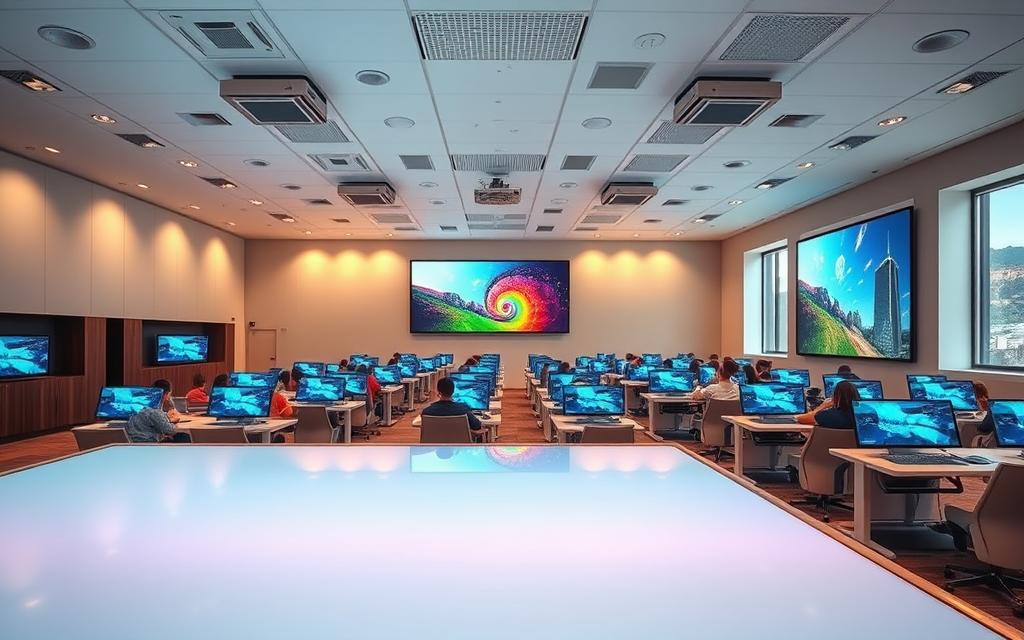
Today’s education is changing fast thanks to new technology. Tools like digital classrooms are making learning more interactive and fun. This helps students get more involved and do better in their studies.
New tech is making it easier for students to learn. They can quickly find lots of information online. Teachers are also using new ways to teach that encourage teamwork.
The edtech impact is big. It’s not just about better learning in class. It also helps students become ready for the digital world and future jobs. It changes how teachers and students talk to each other.
This change is more than just using new gadgets. It’s a big shift in how we learn and grow in our connected world.
The Evolution of Educational Technology
Educational technology has changed a lot over time. It has moved from simple tools to advanced digital platforms. This change has made learning better and opened up knowledge to more people.
Historical Context of Technology in Education
In the past, only a few could learn because resources were rare. Books were hard to find, and learning was for the rich. The first tools helped teachers show things better.
From Overhead Projectors to Interactive Whiteboards
Old teaching tools gave way to new technology. Overhead projectors in the 1950s let teachers show slides to the whole class. This was a big step forward.
Interactive whiteboards in the 1990s changed learning even more. They let teachers:
- Display digital content
- Annotate materials live
- Save and share lessons
- Add multimedia easily
Related Posts:
- Is Technology Making Life Better or Worse The Great Debate

- How Technology Can Help Us in the Future Solving…

- How Technology Contributed to Globalization…

- What Are Some Types of Technology A Guide to Tech Categories

- The Disadvantages of Technology in the Workplace…

- Is Cloaking Technology Real The Science of Invisibility

Key Milestones in EdTech Development
Every new technology in education built on what came before. It made teaching and learning better and opened up new ways to learn.
The Rise of Personal Computers and the Internet
Personal computers in classrooms in the 1980s were a big change. They started with simple tasks but soon became key for many subjects.
The internet changed education even more. It gave students access to endless information. Purdue University researchers say it changed how students learn and work together.
| Time Period | Technology | Educational Impact | Access Level |
|---|---|---|---|
| Pre-1950s | Slate boards, textbooks | Basic knowledge transfer | Limited physical access |
| 1950s-1970s | Overhead projectors, film strips | Enhanced visual learning | Classroom-based sharing |
| 1980s-1990s | Personal computers, CD-ROMs | Interactive learning experiences | School-level availability |
| 2000s-Present | Internet, cloud computing | Global information access | Individual student access |
This change has opened up learning to more people. It has moved from being just for the few to being available to many. New technologies are making learning even more exciting.
How Does Technology Impact Teaching and Learning
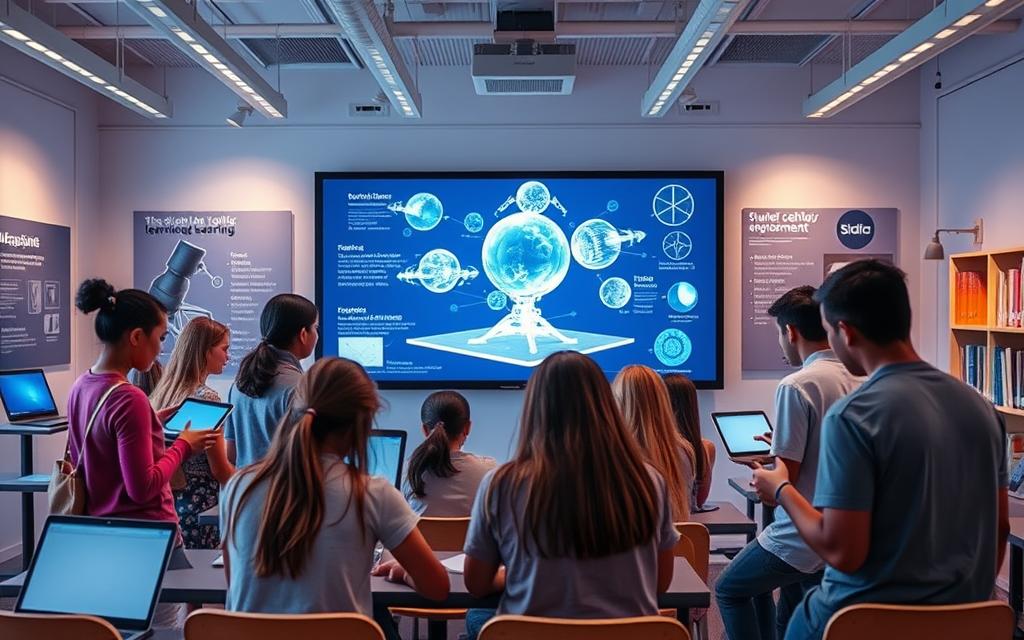
Educational technology has changed classrooms, making them more interactive and responsive. Digital tools have changed how teachers teach, helping them meet different student needs better.
Enhancing Pedagogical Approaches
Modern technology has led to a big pedagogical shift from old teaching methods to new, collaborative ones. This change is one of the biggest in education today.
Shift from Teacher-Centred to Student-Centred Learning
Digital tools help teachers move from being the main source of knowledge to learning facilitators. This lets students take more control over their learning.
As research shows, teachers now act more like “guides” than “sages.” Students use tech to find information, work with others, and think critically.
This student-centred learning makes students more independent and develops important 21st-century skills. When students are involved in their learning, they connect with the material more.
Facilitating Personalised Learning Experiences
Technology makes it possible to offer personalised education like never before. Digital platforms can adjust to different learning speeds, styles, and interests.
Adaptive Learning Software and Customised Content
Adaptive technology is a big step forward in personalising learning. These smart systems check how students do and change the difficulty of content on the fly.
Learning materials are tailored to fill gaps and challenge advanced learners. This ensures each student gets content that’s right for them.
Educational platforms now offer:
- Learning paths based on how students do
- Practice exercises that target specific skills
- Tracking progress with feedback right away
- Content in different formats to suit different learners
This personal approach keeps students engaged by meeting their unique learning needs. Digital tools let teachers tailor lessons while keeping standards high.
Digital Tools Transforming Classroom Instruction
Digital tools have changed classroom instruction a lot. They are now key parts of teaching, making learning places more dynamic. This supports many ways of teaching.
Learning Management Systems
Learning management systems are central for teachers and students. They help share resources and access information. These systems are key to modern digital instruction, making teaching easier and better.
Platforms like Google Classroom and Moodle
Google Classroom is easy to use, thanks to Google’s tools. It helps teachers:
- Create and share assignments easily
- Give feedback on student work quickly
- Organise materials in digital folders
- Talk to students and parents easily
Moodle offers more options for schools. It’s great for universities and colleges because it supports advanced teaching and assessment.
| Feature | Google Classroom | Moodle |
|---|---|---|
| Cost Structure | Free for educational institutions | Open-source (free) |
| Customisation Options | Limited | Extensive |
| Integration Capabilities | Excellent Google ecosystem integration | Supports numerous plugins |
| Mobile Experience | Optimised mobile application | Responsive web design |
Interactive and Collaborative Technologies
Interactive tools have changed how students learn and work together. They help students engage more and move away from just listening to lectures.
Tools such as Padlet and Microsoft Teams for Education
Padlet is like a digital bulletin board. Students can share notes, images, and links in real-time. It’s great for group work and class discussions.
Microsoft Teams for Education makes digital classrooms. It has video calls, file sharing, and messaging. It supports different learning styles, making education flexible.
Technologies like interactive whiteboards, tablets, and LMS have improved education a lot.
These collaborative learning tools make lessons more fun and interactive. They also help students learn digital skills needed for the future. These tools are at the forefront of digital instruction.
Technology’s Role in Student Engagement and Motivation
Modern technology has changed how students learn. It turns passive learning into active participation. Digital tools make learning environments dynamic, where curiosity grows and knowledge stays longer.
Studies show that tech in learning boosts motivation and keeps students focused. A study found that 97% of 149 students felt more engaged with gamified learning.
Gamification and Interactive Learning
Gamification adds game elements to learning, making it fun and rewarding. It uses our natural competitive side to make learning enjoyable.
Educators can use many gamification strategies:
- Point systems for tasks and assessments
- Badges and achievements for mastering concepts
- Progress bars showing learning advancement
- Leaderboards fostering healthy competition
Applications like Kahoot! and Quizlet
Kahoot! makes quizzes fun and interactive. Students use devices to answer questions, competing with classmates.
Quizlet uses flashcards and games to help students remember. It adapts to each student’s progress, focusing on areas needing improvement.
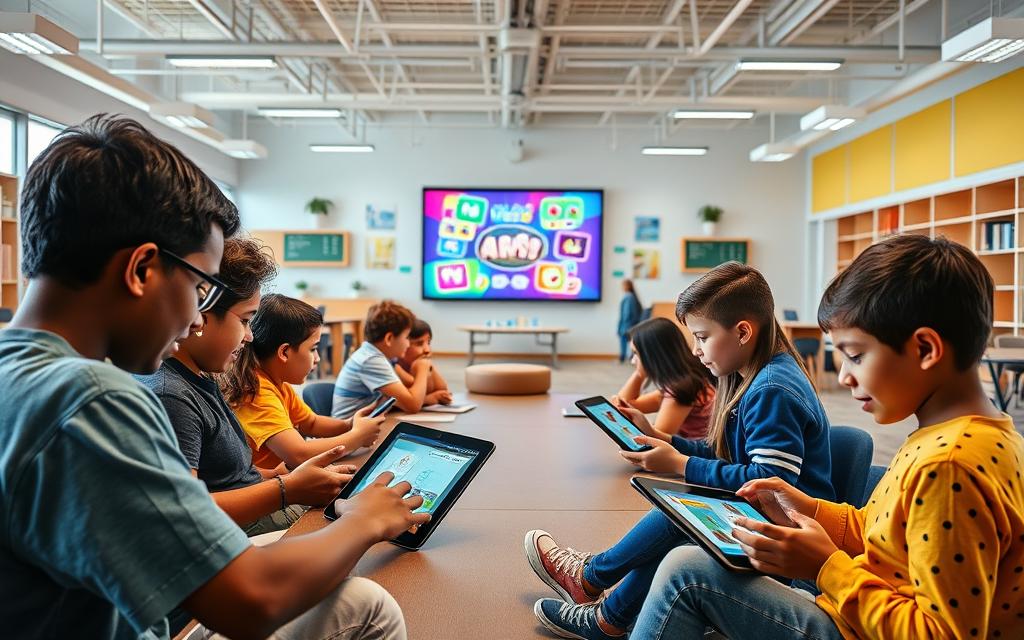
These tools show how interactive education platforms make learning memorable. The competitive and immediate feedback keep students engaged.
Multimedia and Visual Learning Aids
Visual and auditory media help students understand complex ideas. Multimedia tools cater to different learning styles, making abstract ideas concrete.
Educational videos make subjects come alive with demonstrations and animations. Simulations let students experiment safely, observing outcomes.
Use of Videos, Simulations, and Virtual Labs
Virtual labs let science students do experiments safely and easily. They provide real lab experiences with instant data.
Research shows that VR and AR make learning immersive. They simplify complex ideas, turning theory into practical experience.
| Multimedia Tool | Primary Benefits | Subject Applications | Impact on Engagement |
|---|---|---|---|
| Educational Videos | Visual demonstration of processes | All subjects | High visual appeal |
| Interactive Simulations | Hands-on experimentation | Science, mathematics | Active participation |
| Virtual Reality Labs | Immersion in environments | Science, history, geography | Complete sensory engagement |
| Augmented Reality | Overlay information on real world | STEM subjects, arts | Novelty and wonder |
These technologies keep student engagement high by using different senses. They offer a richer learning experience, fitting various preferences and abilities.
When used well, gamified learning and multimedia change education. Students become active learners, not just passive receivers. They form deeper connections with what they learn.
Accessibility and Inclusivity Through Technology
Technology is a great equaliser in education, helping to remove barriers. It allows educators to make learning spaces where all students can succeed. This is true, no matter their personal challenges or needs.
Assistive Technologies for Diverse Learners
Now, there are many tools to help students with different abilities. These tools change how students learn by giving them new ways to understand and interact with material.
Text-to-Speech Software and Screen Readers
Text-to-speech software turns written text into spoken words. This helps students with visual or reading issues. Screen readers go further by describing what’s on the screen, making digital content accessible to all.
Tools like JAWS and NVDA help students navigate online learning. They allow students to access learning materials on their own, just like their classmates.
Bridging Socioeconomic Gaps with EdTech
Technology is key in closing educational gaps between communities. It helps ensure all students get a fair chance to learn, no matter their background.
Initiatives for Equal Access to Digital Resources
Many programmes aim to bring technology to those who need it most. These include:
- Device donation schemes giving laptops and tablets to low-income families
- Subsidised internet access for school use
- Free educational resources that cut down on textbook costs
- Community tech centres for after-school use
As an education advocate says:
Accessibility means giving everyone, despite their disabilities or medical needs, the tools to interact equally. And inclusion means having enough space to join in and contribute in learning once you have equal access to tools.
These efforts show how technology can make learning inclusive for all. When done right, they let every student fully take part in their education.
Challenges and Barriers in Integrating Technology
Educational technology has great promise, but it faces big hurdles. These obstacles can make technology less effective. It’s important to plan carefully to make sure technology helps learning, not hinders it.
Digital Divide and Equity Issues
The digital divide is a major challenge in education today. It’s the gap between those with and without digital access. This gap affects how well students learn.
Disparities in Access Across Different Regions
Technology access varies a lot between cities and rural areas. It also differs based on how much money families have. Students in poorer schools often lack the internet, devices, and digital tools that richer schools have.
This creates an unfair situation. Some students get to use the latest educational tools, while others have old or no technology. The gap is not just about hardware but also about digital skills and support.
Teacher Training and Professional Development
Using technology well in class needs more than just devices and software. Teachers must be trained to use these tools effectively. This makes teacher training very important.
Necessity for Ongoing EdTech Skills Training
Technology changes fast, so teachers need to keep learning. Many feel they’re not ready to use new tech in their teaching. This is a big barrier to using technology in class.
As one expert says, “Technology works best when students keep learning to use it well. If we don’t keep adapting, its benefits won’t last.”
Schools need to keep investing in teacher training. This should include:
- Hands-on workshops with the latest educational technology
- Time for teachers to plan how to use technology together
- Programmes that pair experienced and new teachers
- Updates on new tools and best practices
This ongoing learning helps teachers use technology to its best. Experts say, “It’s up to those who design education and technology to use them to change education.”
To overcome these challenges, we need a plan that includes better infrastructure, teacher training, and ongoing support. Only with a united effort can schools make technology work for everyone.
Data-Driven Instruction and Assessment
Data-driven methods change how teachers track student progress and check learning results. These new ways use advanced tech to give insights that improve teaching and student success.
Analytics for Monitoring Student Progress
Today’s learning analytics tools give a clear view of how students do. They gather and study data from many places to build detailed student profiles.
Tools like PowerSchool and Illuminate Education show how students are doing in real time. Teachers can spot where students need help and act fast.
These tools turn numbers into useful advice for teaching. They help teachers tailor lessons to meet each student’s needs.
Tools like PowerSchool and Illuminate Education
PowerSchool is a full package for managing student info and analytics. It has strong reporting tools for tracking progress in many areas.
Illuminate Education focuses on analysing assessment data and educational insights. It combines different data sources for a full view of student progress.
Both systems help teachers, admins, and support staff work together. This teamwork ensures students get the support they need at every step.

Formative and Summative Assessment Technologies
Today’s assessment tech includes both formative and summative methods. These tools give feedback as students learn, not just at the end.
Formative tools check in during learning. They let teachers adjust lessons based on what students understand.
Summative tools measure learning at set times. They give a full picture of how well students meet standards.
Online Quizzing and Automated Grading Systems
Online quizzes change how we assess and get feedback. They give quick results and detailed insights into how students do.
Automated grading cuts down teacher work while giving students fast feedback. As one source notes:
“With tools like Explorance Blue, giving feedback is easier. Students can share their thoughts easily. This helps teachers make better choices.”
These tools help make learning fit each student’s needs. AI looks at how students do and adjusts questions and challenges.
AI makes assessments more accurate and personal. Another source says:
“AI makes learning personal. It looks at how students do and gives feedback right away.”
These advanced tools create a full system for checking how well students learn. They help teachers by making their work easier and students by giving them feedback right away.
Future Trends in Educational Technology
The world of education is on the verge of a big change thanks to new tech. These new tools will make learning more fun, personal, and real for everyone.
Artificial Intelligence and Machine Learning
Artificial intelligence is a big deal in future edtech. It uses machine learning to look at lots of data and guess how well students will do.
This tech helps create learning systems that change how they teach based on what each student needs. It’s not just about making things easier; it’s about making learning smarter.
AI Tutors and Predictive Analytics in Education
AI tutors give students feedback right away and help them learn better. They change how they teach based on how each student learns best.
Predictive analytics tools spot students who might struggle early on. They look at how students do in class and how often they participate. This helps teachers help students before it’s too late.
Teachers can use this info to help students before they fall behind. It’s a big change from just reacting to problems to actively helping students succeed.
Virtual and Augmented Reality Applications
Immersive tech takes learning beyond the classroom. Virtual and augmented reality let students experience things in a new way.
These tools make hard ideas easy to understand and let students practice skills safely. Virtual reality learning lets students go on virtual trips to places they can’t visit in real life.

The Oculus Rift shows how virtual reality can change learning. Students can go on virtual field trips to places like historical sites or even space.
These experiences make learning more exciting and memorable. They help students connect with what they’re learning in a way that books and lectures can’t.
Medical students can practice surgeries safely, and history students can see events come to life. The possibilities are endless.
| Immersive Platform | Educational Focus | Key Features | Subject Applications |
|---|---|---|---|
| Oculus Rift | Virtual field trips | Full immersion, motion tracking | History, Science, Geography |
| Microsoft HoloLens | Augmented reality overlays | Mixed reality, hands-free interaction | Engineering, Anatomy, Architecture |
| Google Expeditions | Classroom VR experiences | Teacher-guided tours, affordable | Social Studies, Art, Biology |
| zSpace | Interactive learning stations | 3D visualisation, stylus interaction | Physics, Chemistry, Technical education |
| ClassVR | Curriculum-aligned content | Classroom management, pre-loaded content | Primary through secondary education |
These technologies are getting better and more focused on education. The future looks bright for making learning more fun and effective for everyone.
Education tech is getting smarter, more personal, and more exciting. These changes will make learning better for all students.
Global Perspectives on Technology in Education
Educational technology knows no borders, opening doors to cross-cultural learning. The world of global education technology shows us how different countries use technology in schools. Each region has its own way of adopting and using technology in education.
Comparative Analysis of EdTech Adoption
Every country has its own way of using digital learning. The United States and the United Kingdom are interesting examples of how different countries approach technology in schools.
Case Studies from the United Kingdom and United States
In the UK, schools follow a centralised plan for using technology. The government plays a big role in making sure technology is used everywhere. This focus on digital skills in all subjects helps create a standard way of using technology in schools.
In the US, schools have a more varied approach. Each state and district decides how to use technology. This means some schools focus on specific areas, but it can also mean different levels of access to technology.

Both countries see technology as a way to connect students to the world. For example, students in rural America can join virtual field trips to the Arctic. They can share their findings with students in other states.
International Collaborations via Technology
Technology has changed how students work together across the globe. These partnerships help students understand different cultures and learn important digital skills.
Programmes like eTwinning and Global School Networks
eTwinning is a great example of international teamwork. It brings classrooms together in Europe for projects and cultural exchanges. Teachers work together on lesson plans, and students share learning goals.
Global school networks help schools around the world work together. They use a mix of face-to-face and online learning. This helps students stay connected with their home countries while studying abroad.
These efforts show how technology can connect educational systems worldwide. They give students real audiences for their work and prepare them for a more connected world.
Conclusion
Digital tools have changed classrooms a lot. They make learning fun and personal with tools like Google Classroom. This helps students learn in a way that suits them best.
But, there are challenges like not everyone having access to technology. Also, teachers need training to use these tools well. Yet, new tech like AI and VR looks promising for learning.
By solving these problems, schools can make sure everyone gets to use these tools. This will help students learn in exciting new ways.
Technology in schools is key for students’ future success. It teaches them important digital skills. It also helps create a community where everyone feels included.
As technology keeps getting better, so will teaching and learning. We can look forward to even more innovative ways to learn in the future.
FAQ
How has technology transformed traditional teaching methods?
Technology has changed teaching from focusing on the teacher to focusing on the student. It uses tools like adaptive software and digital platforms. These tools help with personalised learning, teamwork, and quick access to resources. This makes classrooms more dynamic and responsive.
What are some key milestones in the evolution of educational technology?
Important milestones include the use of overhead projectors, personal computers in classrooms, and the internet. Then came interactive whiteboards and platforms like Google Classroom and Moodle. Each step has made learning more accessible and resource-rich.
How does technology support personalised learning experiences?
Technology helps with personalised learning through adaptive software and custom content. This content adjusts to each student’s needs, pace, and learning style. It lets teachers tailor lessons for different learners.
Which digital tools are revolutionising classroom instruction today?
Tools like Google Classroom, Moodle, Padlet, and Microsoft Teams for Education are changing teaching. They centralise resources, enable teamwork, and simplify tasks. This supports both live and recorded learning.
How does technology improve student engagement and motivation?
A> Technology boosts engagement with apps like Kahoot! and Quizlet, and multimedia like videos and simulations. It makes learning fun, competitive, and immersive. This keeps students interested and involved.
In what ways does technology promote accessibility and inclusivity in education?
Technology helps with accessibility through tools like text-to-speech software and screen readers. It also helps bridge economic gaps, ensuring all can access digital resources. This creates inclusive learning spaces for everyone.
What are the main challenges in integrating technology into education?
Challenges include the digital divide and the need for teacher training. Teachers must learn to use technology well to benefit from it fully.
How is technology used for data-driven instruction and assessment?
Technology helps with data-driven teaching through analytics platforms like PowerSchool and Illuminate Education. These tools track progress and offer insights. They also support assessments that give immediate feedback and help tailor learning.
What emerging trends are shaping the future of educational technology?
Trends include AI and machine learning for tutoring and predictive analytics. Virtual and augmented reality, like Oculus Rift, are also emerging. These will deeply change how we learn.
How does educational technology adoption vary globally?
Adoption varies by region. Countries like the UK and US have different strategies. International programmes like eTwinning connect classrooms worldwide. This promotes cultural exchange and teamwork.