


Innovation and discovery have changed our world in amazing ways. Many people ask about the start of these changes and how they relate.
This look into history shows how ideas and actions have mixed over time. It’s not just a simple timeline.
We’ll follow the journey from early human ideas to today’s team work. We’ll see how these areas have helped each other through history.
This historical perspective shows that science and technology are like a dance, not a race. Knowing how they’ve grown helps us understand human success.
Deconstructing the Enduring Query
The debate on whether science comes before technology or the other way around is intriguing. It has puzzled scholars for ages. We need to look closely at the basics before we can reach any conclusions.
Establishing Definitions: Science Versus Technology
To tackle this complex issue, we must first define science and technology clearly. Science is about seeking knowledge through experiments and theories. It aims to understand the world and make predictions.
Technology, on the other hand, uses knowledge to solve problems and improve our lives. It involves creating tools and systems based on scientific discoveries.
Here are some key differences:
- Science seeks knowledge for understanding
- Technology applies knowledge for practical purposes
- Science answers “why” questions about nature
- Technology addresses “how” to achieve specific outcomes
Related Posts:
- Is Technology Making Life Better or Worse The Great Debate

- How Technology Contributed to Globalization…

- The Disadvantages of Technology in the Workplace…

- How Technology Impacts Teaching and Learning Modern…

- What Are Some Types of Technology A Guide to Tech Categories

- How Technology Can Help Us in the Future Solving…

The Inherent Complexity of a Linear Answer
The relationship between science and technology is not straightforward. It’s a complex loop where each informs and changes the other.
This complexity of innovation shows in several ways:
- Technological advancements often lead to new scientific discoveries
- Scientific breakthroughs inspire new technologies
- Practical problems in technology lead to new scientific questions
Looking back, science and technology have always been closely linked. Sometimes, technology comes first, and sometimes, science does. This back-and-forth has driven human progress.
In today’s world, the lines between science and technology are getting blurred. This mix-up is shaping how we research and develop new things.
The Dawn of Humanity: Technology’s Primacy
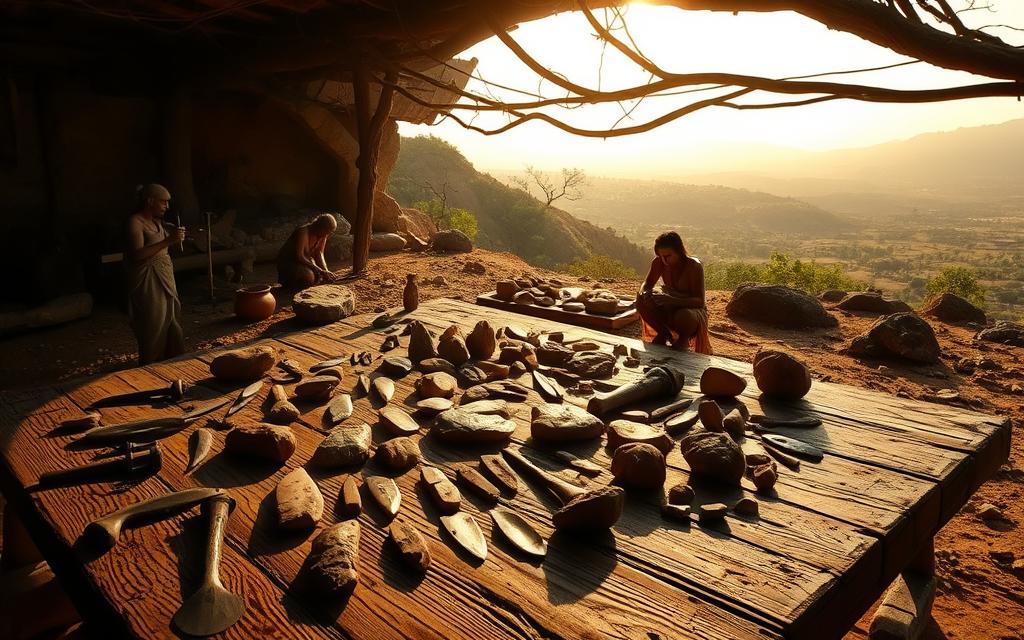
Long before science began, our ancestors showed great skill in technology. The early days of human history show how need drove innovation. They made things first, then figured out how they worked.
Palaeolithic Innovation: Tools Preceding Theory
The Oldowan stone tools, from 2.6 million years ago, mark the start of human technology. These tools were made through trial and error, not theory. Early humans made early human tools by watching and learning from their actions.
This palaeolithic technology helped our ancestors to eat, live, and protect themselves. They passed on their knowledge by showing, not telling. This discussion overlaps with some tech categories, especially for readers comparing came first science with similar issues. Each new generation added to what was known, without understanding the reasons behind it.
Harnessing Fire: An Evolutionary Catalyst
Controlling fire was a key step in fire invention history. It’s believed that humans started using fire about 1.7 million years ago. This skill changed human life in big ways.
Fire gave warmth, safety, and allowed for cooking. Cooking made food easier to digest and saved time. These benefits came before we understood fire's chemistry. This discussion overlaps with contributed globalization connecting world, especially for readers comparing came first science with similar issues. The palaeolithic technology of fire use grew from watching and trying.
The story of our earliest achievements shows technology’s key role in our evolution. These innovations came from solving immediate problems. They set the stage for later scientific discoveries.
Ancient Civilisations: Empiricism and Early Theory
The great empires of old left us not just grand buildings but also ideas that shaped our progress. This time was key, where hands-on knowledge and theory started to mix. Each one influenced the other in big ways.
Monumental Engineering: The Pyramids and Beyond
Egypt showed amazing skill in building projects that amaze today’s engineers. The Egyptian pyramids are a testament to the knowledge built up over time through trial and error.
These incredible structures needed a deep understanding of:
- Mathematics and geometry for exact measurements
- Material science for choosing and moving stones
- How to manage large projects and teams
- How to align with the stars
This ancient engineering was mostly based on doing things over and over. Builders learned by doing, creating structures that last for ages.
Greek Philosophical Enquiry and the Seeds of Science
While Egyptians focused on doing, Greeks started to think about why things happen. This was the start of Greek philosophy science. They tried to explain the world through reason, not just need.
Aristotle was a big name here. He helped set up ways to:
- Observe and sort things out
- Use logic to figure things out
- Find reasons for natural events
- Start making theories about life and the world
The Library of Alexandria was a key place. It was where practical knowledge met deep thinking. Scholars from all over shared ideas, mixing hands-on skills with deep thinking.
This mix was a big step forward for our minds. Greeks started asking “why” things happen, not just “how” to do them. This was the start of the scientific method.
The Medieval Epoch: Knowledge Transmission and Application
The medieval period was a time of great change in how knowledge was shared and used. It’s often seen as a dark time, but it was actually filled with important discoveries. These discoveries came from two main ways of innovating.

The Islamic Golden Age: Synthesising Disciplines
From the 8th to the 14th century, the Islamic world saw a burst of intellectual growth. Scholars in places like Baghdad, Cairo, and Córdoba built on ancient knowledge. They also made new discoveries.
This was a time when science and technology grew together. Mathematician Al-Khwarizmi created algebra, and astronomer Al-Battani made detailed star observations.
Ibn al-Haytham (Alhazen) changed the field of optics with his Book of Optics. He mixed theory with practical tests, setting standards that last to this day.
Key features of Islamic medieval science were:
- Translation and keeping of old texts
- Creating new ways to test ideas
- Linking maths with real-world uses
- Starting universities and libraries
European Craft Guilds: Practical Knowledge Systems
In Europe, knowledge grew in a different way. Craft guilds became strong groups that controlled trades and set quality standards.
These guilds taught skills through apprenticeships. Master craftsmen taught by doing, not just by talking about it.
The guild system led to big advances in:
- Working with metals and making metal items
- Building and construction methods
- Textile making and dyeing
- Creating clocks and precise tools
This method focused on learning by doing. Over time, it built up complex ways of making things, without needing scientific theories.
Both systems show how medieval science and technology grew in different ways. One used theory and practice together, while the other focused on practical skills.
The Scientific Revolution: A Paradigm Shift
The 16th and 17th centuries saw a big change in how people saw the world. This time, known as the scientific revolution, moved away from old ideas. Instead, new thinkers focused on facts and maths.
This big change brought new ways to study nature. It changed how we see the world. And it’s shaped science today.
Formalising the Scientific Method
Before this, science was based on old ideas. The scientific revolution brought new ways to learn. Francis Bacon and René Descartes helped create the scientific method.
This method is all about:
- Watching and measuring things carefully
- Creating testable ideas
- Doing experiments
- Checking and repeating findings
This method lets science get better over time. It’s based on evidence, not just old ideas.
“The entire method consists in the order and arrangement of the things to which the mind’s eye must turn so that we might discover some truth.”
Instrumental Advances: Technology Fuelling Discovery
New tools were key to the scientific revolution. They let people see things they couldn’t before. This led to more discoveries and better tools.
Some important tools from this time are:
| Instrument | Inventor/Developer | Primary Contribution |
|---|---|---|
| Compound Microscope | Zacharias Janssen | Revealed microscopic world |
| Barometer | Evangelista Torricelli | Measured atmospheric pressure |
| Air Pump | Otto von Guericke | Created vacuum for experimentation |
| Precision Clocks | Christiaan Huygens | Enabled exact time measurements |
These tools helped turn ideas into things we can test. This made science more reliable.
The telescope is a great example of how technology helps science. Galileo’s telescope showed us new things in space. His work changed how we see the universe.
Galileo found many things with his telescope, like:
- Lunar mountains and craters
- Jupiter’s moons
- Venus’s phases
- Many stars we can’t see
This shows how new tools can lead to big discoveries. The telescope didn’t just support old ideas. It showed us new things that changed our understanding.
The scientific revolution was a big turning point. It showed how technology and science work together. This is how we innovate today.
The Industrial Revolution: A Symbiotic Explosion
The 18th and 19th centuries saw a big change. Science and technology started working together. This changed human society in big ways.

From Thermodynamics to the Steam Engine
Understanding thermodynamics made steam engines better. French physicist Sadi Carnot wrote Reflections on the Motive Power of Fire in 1824. His work helped engineers make steam technology more efficient.
James Watt had already made steam engines work better. But Carnot’s ideas gave a scientific base for more improvements. This made a cycle where better engines led to more precise experiments, and so on.
This shows how science and engineering go hand in hand. Scientific ideas helped design better machines. And the need for better machines led to more scientific research.
The Birth of Modern Engineering and Applied Science
The Industrial Revolution made science and technology work together. Engineering became a science-based field. It moved from being just a craft to using math and science.
New schools for applied science started. The École Polytechnique in Paris (1794) and others in Britain and Germany were set up. They trained people to link science and technology.
Research and development became key. Companies started research departments. They saw that science could lead to new technologies and help them stay ahead.
| Scientific Discovery | Technological Application | Impact on Industry |
|---|---|---|
| Thermodynamics Laws | Improved Steam Engines | Enhanced Manufacturing Power |
| Electromagnetic Theory | Telegraph Systems | Revolutionised Communications |
| Chemical Principles | Synthetic Dyes & Fertilisers | Transformed Textiles & Agriculture |
| Material Science | Structural Engineering | Enabled Railways & Bridges |
The Industrial Revolution showed that science and technology do best when together. This partnership has kept changing our world ever after.
The Modern Era: Intertwined Destinies
The twentieth and twenty-first centuries are fascinating. Science and technology are so linked, it’s hard to tell them apart. They now feed into each other, creating a cycle of innovation and discovery.

The Manhattan Project: Science Directing Technology
The Manhattan Project is a great example of science leading technology. It turned nuclear physics into a devastating weapon during World War II.
Scientists like Oppenheimer, Fermi, and Bohr used Einstein’s famous equation. They applied quantum mechanics to engineering, making the impossible possible.
This project needed scientists, engineers, and manufacturers to work together. It showed how science can drive huge technological leaps.
The Information Age: A Self-Perpetuating Cycle
The information age is a prime example of science and technology working together. It’s a cycle where each step leads to the next breakthrough.
Computer science led to better hardware, which allowed for more complex software. This software then enabled new scientific research, leading to more technology.
This cycle continues with artificial intelligence and quantum computing. Each new technology opens up new scientific possibilities, and vice versa.
The Semiconductor and Integrated Circuit
The history of semiconductor history is a perfect example of this cycle. It started with basic research and became the basis of modern computing.
Scientists studying semiconductors in the 1940s and 1950s couldn’t have imagined their impact. Their work on silicon led to the invention of the transistor.
Transistors then led to integrated circuits, making personal computers possible. These computers are now key for scientific research in all fields.
Today’s microprocessors have billions of transistors, all starting from that initial curiosity. This shows how science can spark technological revolutions, opening up new scientific areas.
What Came First, Science or Technology? Analysing the Evidence
Looking back through history, we find ourselves questioning which came first. From simple tools to complex computers, the journey is complex. It shows a mix-up in who came first.
Modern studies offer deep insights into this puzzle. The field of Science, Technology, and Society (STS) is key. It helps us see how science and technology work together.
Contemporary Philosophical Frameworks
STS scholars like Thomas Kuhn and Thomas Hughes have changed how we view progress. Kuhn’s idea of paradigm shifts shows science can follow technology, not always lead.
Hughes looked at big technological systems. He found that innovation often comes from solving problems, not just from science.
Today, we understand that science and technology are linked in a circle. Technology can push science forward, and science can lead to new tech.
Reconciling the Historical Narrative
History shows a back-and-forth relationship, not a straight line. Early humans used tools before they understood science. They made tools and used fire long before they had theories.
Ancient people built amazing things using what they knew, not just theories. Pyramids and other wonders show their tech skills without needing science.
The history of science shows a shift. The Scientific Revolution brought methodical science that guided tech. Now, we see both ways happening.
In today’s world, it’s hard to say who comes first. Sometimes tech leads, sometimes science does.
| Historical Period | Primary Direction | Key Example | Nature of Relationship |
|---|---|---|---|
| Prehistoric Era | Technology → Practice | Stone tool making | Empirical development |
| Ancient Civilisations | Technology → Engineering | Pyramid construction | Practical knowledge systems |
| Scientific Revolution | Science → Technology | Microscope development | Method-driven innovation |
| Modern Era | Reciprocal influence | Computer technology | Bidirectional development |
This historical reconciliation shows that it’s not always clear who comes first. Each time in history, the relationship between tech and science is different.
The science technology debate keeps giving us new ideas. Instead of saying one is always first, we look at when each leads the way.
Conclusion
Our journey through history shows a complex link between science and technology. From stone tools to quantum computing, these areas have grown together. They haven’t followed a simple path.
At first, technology came before science. People used fire and built pyramids because they needed to, not because they understood the science behind it.
The Scientific and Industrial Revolutions changed things. Then, science started to push technology forward. This created a cycle where each helps the other grow.
The debate on science and technology’s roles is ongoing. They’ve led and followed each other at different times. This depends on the culture, economy, and knowledge of the era.
Seeing how science and technology work together helps us understand how we learn. It shows that progress comes from both doing and thinking. It’s about making and knowing.
FAQ
What is the main difference between science and technology?
Science is about studying the world through experiments and observations. Technology uses science to create tools and solve problems. It’s about making things work for us.
Did science or technology come first in human history?
At first, technology came before science. People made tools and controlled fire by trial and error. Later, science and technology became more connected.
How did ancient civilisations contribute to the development of science and technology?
Ancient people were skilled in engineering and started to think about why things work. The Egyptians built pyramids and Greeks like Aristotle asked big questions. They laid the groundwork for science.
What role did the Islamic Golden Age play in the relationship between science and technology?
During the Islamic Golden Age, scholars like Alhazen mixed observation with theory. They showed how science and technology can work together to create new things.
How did the Scientific Revolution change the interaction between science and technology?
The Scientific Revolution made science more formal. People like Francis Bacon and René Descartes focused on testing ideas. This led to discoveries like Galileo’s use of the telescope, showing how technology can help science.
In what ways did the Industrial Revolution demonstrate synergy between science and technology?
The Industrial Revolution was a time when science and technology worked together closely. Advances in thermodynamics helped improve machines like the steam engine. This led to more research and growth in industry.
Can you provide an example of modern interdependence between science and technology?
The Manhattan Project is a great example. It used science to create the atomic bomb. Today, technology like semiconductors drives new discoveries, which then lead to more innovation.
How do contemporary scholars view the historical relationship between science and technology?
Today, experts like Thomas Kuhn and Thomas Hughes see science and technology as connected but not one-way. They say technology came first, but now they influence each other. This is how we get new ideas and inventions.