

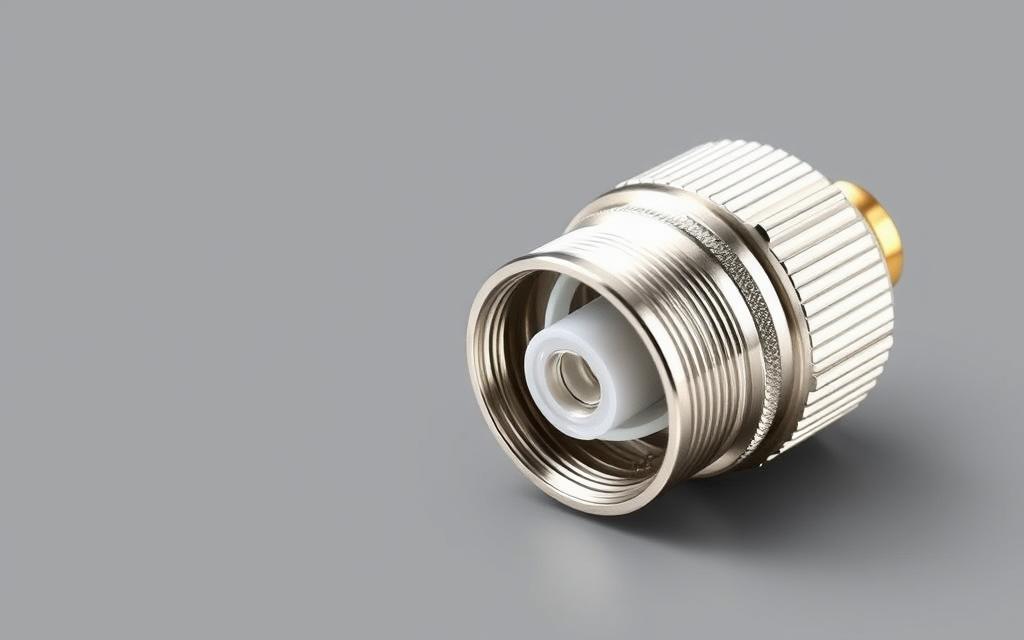
In the world of radio frequency connections, you’ll often see the term SMA. It stands for SubMiniature version A, a specific coaxial connector type.
These connectors were created in the 1960s. Engineers made them for a simple connection to coaxial cables.
The SMA connector has a unique screw-type coupling. This ensures it stays securely connected in many electronic systems.
These parts keep a consistent 50 Ω impedance. This makes them perfect for sending high-frequency signals.
Knowing rf connector basics is key for technicians. It helps them work better with antennas and communication gear. The sma antenna meaning is clearer when you see its role in keeping signals strong.
This introduction covers the basics of these vital connectors. Later sections will dive deeper into their uses and technical details.
Defining SMA: Origins and Meaning in Technology
To understand SMA connectors, we need to look at their name and history. They are a big step in radio frequency technology. They meet the need for smaller sizes and better performance in electronic systems.
What SMA Stands For: SubMiniature Version A
The sma acronym means SubMiniature Version A. This tells us a lot about the connector.
Related Posts:
- The Disadvantages of Technology in the Workplace…

- What Are Some Types of Technology A Guide to Tech Categories

- Is Technology Making Life Better or Worse The Great Debate

- Is Cloaking Technology Real The Science of Invisibility

- How Technology Contributed to Globalization…

- How Technology Can Help Us in the Future Solving…

“SubMiniature” means it’s smaller than old RF connectors. “Version A” shows it’s the first in a series of small coaxial connectors.
This name came from the need to show it’s different from bigger connectors. It also shows its place in the product family.
The Historical Context of SMA’s Development
SMA connectors started in the early 1960s. This was a time of fast growth in microwave and radio frequency tech. Engineers at Bendix Scintilla (now Amphenol Corporation) saw the need for smaller, better connectors.
Several things pushed for SMA’s creation:
- Higher frequencies in communication systems
- Less space in new devices
- Better reliability in tough places
- Standardisation in military and space
The goal was to make a connector for up to 18 GHz. It had to be small but work well. This led to big improvements in many fields.
| Characteristic | Original SMA Design | Previous Generation Connectors | Performance Improvement |
|---|---|---|---|
| Maximum Frequency | 18 GHz | 4 GHz | 350% increase |
| Connector Diameter | 0.312 inches | 0.625 inches | 50% reduction |
| VSWR at 10 GHz | 1.05:1 | 1.30:1 | 19% improvement |
| Operating Temperature | -65°C to +165°C | -55°C to +125°C | Extended range |
The table shows how Bendix Scintilla engineers made big steps. They fixed old problems and set new standards for small, high-performance connectors.
This was a key moment in RF connectivity. It set the stage for future connector designs. SMA showed that small can be powerful, leading to more innovation.
Technical Anatomy of SMA Connectors
SMA connectors are top-notch for radio frequency use. They have a smart design and materials for the best performance in many conditions.
Physical Structure and Design Elements
SMA connectors have three main parts. The outer shell is strong and shields from electromagnetic fields. It’s made of brass or stainless steel, plated with gold or nickel to stop rust.
The centre contact carries the signal. It’s often brass or beryllium copper. Gold plating keeps it conducting well and prevents corrosion.
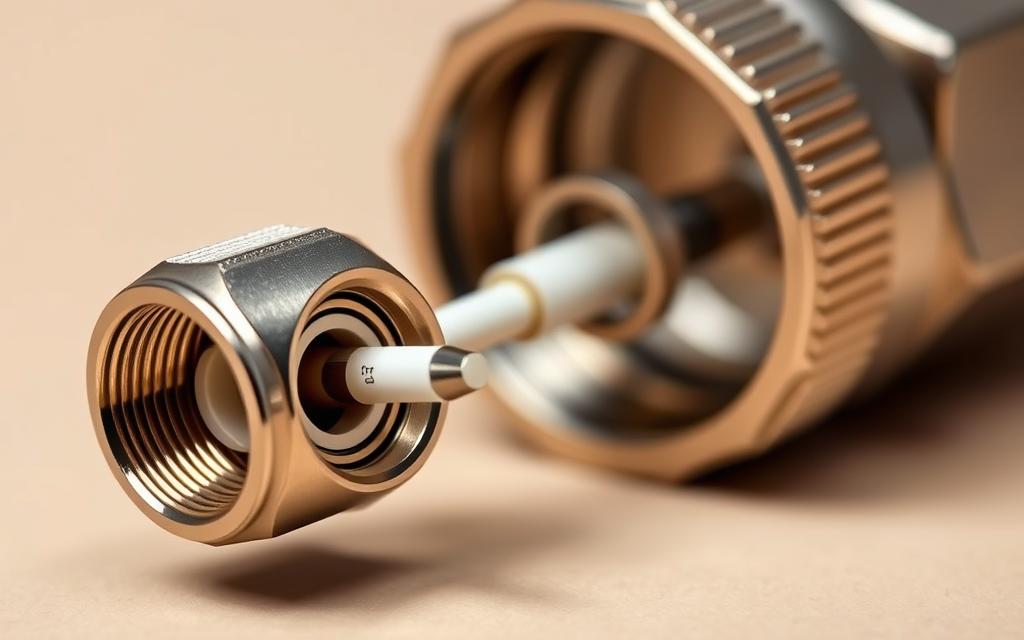
The choice of materials is key. Brass is good for the outer shell because it’s easy to work with and affordable. Beryllium copper is used for centre contacts because it’s springy.
The insulator is a critical part. High-quality SMA connectors use PTFE. This ptfe dielectric is great for electrical and thermal stability.
PTFE works well in extreme temperatures, from -55°C to +165°C. It keeps signals strong at high frequencies. Plus, it’s easy to assemble and maintain because it’s non-stick.
Electrical Performance Metrics
SMA connectors are top-notch for RF use. They’re designed to keep signals strong with little loss.
They always have a 50 ohm rating. This ensures signals travel well without losing power. Engineers can use them in 50-ohm systems without worrying about impedance changes.
50 Ohm Impedance and Frequency Ranges Up to 18 GHz
The 50-ohm standard is widely used for good reasons. It balances power handling and signal loss well. SMA connectors keep this impedance through careful design and material choice.
They work well from DC to 18 GHz. Some special versions even go up to 26.5 GHz.
The table below shows how different SMA connector grades perform:
| Connector Grade | Frequency Range (GHz) | VSWR Maximum | Insertion Loss (dB) |
|---|---|---|---|
| Standard | 0-18 | 1.30+0.05f | 0.15 |
| Precision | 0-26.5 | 1.07+0.027f | 0.10 |
| Instrumentation | 0-18 | 1.05+0.002f | 0.05 |
SMA connectors are a top choice for test equipment and high-frequency systems. Their solid build and electrical prowess make them essential in RF engineering today.
Varieties of SMA Connector Configurations
SMA connectors come in different types for various uses. Knowing these types is key for choosing the right parts and ensuring they work well together.
Standard SMA and Reverse Polarity (RP-SMA)
The standard SMA connector has a consistent design. But, the reverse polarity SMA, or RP-SMA connector, has a different setup. This makes it not work with standard SMA connectors.
RP-SMA connectors were made for wireless devices to meet rules. Brands like Netgear and Linksys use them in their Wi-Fi products as of 2018.
Key Differences and Identification Tips
To spot RP-SMA connectors, look at the centre contact:
- Standard female SMA has a centre sleeve
- RP-SMA female has a male pin instead
- Standard male SMA has a centre pin
- RP-SMA male has a centre sleeve for a female pin
This difference means SMA and RP-SMA connectors can’t fit together. This stops them from connecting wrongly.
Gender Definitions: Plug (Male) and Jack (Female)
Knowing the connector gender is vital for connecting systems right. The SMA male female terms are important but need careful checking.
The plug (male) has a centre pin and internal threads. The jack (female) has a centre sleeve and external threads. This design helps them connect securely and correctly.
Ensuring Proper Mating and Connectivity
For SMA connectors to work right, you need to consider both how they fit and how they connect:
- Make sure you know the connector’s gender before trying to connect
- Check if the connector is standard or reverse polarity
- Clean the threads before connecting
- Use the right amount of force when connecting – about 5-7 inch-pounds
- Check the centre contacts are straight and clean
Connecting them correctly helps keep signal quality high. Wrong connections can harm the contacts and the system.
What Does SMA Mean in Technology Applications
SMA connectors are more than just technical specs. They show their worth in many real-world uses across different fields. These parts are key in many communication and signal systems.
Critical Role in Radio Frequency (RF) Systems
In RF systems, SMA connectors are top-notch. They keep signal loss low and match impedance well. This makes them perfect for high-frequency tasks.
Use in Cellular Base Stations and Microwave Links
Today’s mobile networks rely on SMA connectors for base stations. They ensure precise signal transmission. Their strong build also stands up to tough environments.
Microwave systems use SMA connectors for long-distance data links. These connections keep data quality high over long distances. The connectors also block interference in sensitive microwave systems.
Integration in Wireless and Antenna Technologies
Wireless tech gets a big boost from SMA connectors. They offer reliable links between devices and antennas. This ensures top performance across many wireless standards.
Examples in GPS, Wi-Fi Routers, and Satellite Communications
GPS modules use SMA connectors for antenna links. This keeps signal quality high for accurate positioning. Many GPS systems, both commercial and military, use these connectors.
Wi-Fi routers often have SMA connectors for external antennas. Different models use standard or reverse polarity SMA. This lets manufacturers tailor antenna setups for best performance.
Satellite comms rely on SMA connectors for their high-frequency needs. These parts handle the tough signal demands of satellite communications. They work well in both commercial and military systems.
| Application Area | SMA Connector Type | Frequency Range | Primary Benefit |
|---|---|---|---|
| Cellular Infrastructure | Standard SMA | 0.5-6 GHz | Weather Resistance |
| Wi-Fi Systems | RP-SMA | 2.4-5.8 GHz | Interference Prevention |
| Satellite Comms | Precision SMA | Up to 18 GHz | Signal Integrity |
| Medical RF Devices | Medical-grade SMA | 1-8 GHz | Safety Compliance |
Fields like radio astronomy and medical diagnostics also use SMA technology. Radio telescopes use SMA for frequencies above 5 GHz, needing precise signals. Medical devices use SMA for reliable RF signals in diagnostics or treatments.
Benefits of Employing SMA Connectors
Engineers choose SMA connectors for their top-notch electrical and mechanical qualities. These parts offer sma connector advantages that boost system performance in many areas.
Superior Electrical Performance and Low VSWR
SMA connectors keep signals strong at high frequencies. Their exact design cuts down signal reflection, leading to low vswr levels. This ensures efficient power transfer, perfect for sensitive RF tasks.
The threaded connection ensures a steady electrical link. This stops impedance issues that could harm system quality. Many SMA types work well up to 18 GHz, with some reaching 26.5 GHz.
These features help send signals more clearly. Less signal loss means better data quality in communication systems. The design also cuts down on electromagnetic interference in busy electronic spaces.
Robustness and Environmental Resistance
SMA connectors are very durable in tough conditions. Most high-quality SMA connectors can handle up to 500 connections without losing performance. This means less need for upkeep and fewer replacement costs.
They also stand up well to different environmental stresses. Their temperature range is usually from -65°C to +155°C. This makes them reliable in extreme weather and industrial settings.
Manufacturers use materials that fight off corrosion, moisture, and vibration. The threaded connection keeps them securely in place. These qualities make SMA connectors great for military, aerospace, and outdoor use where dependability is key.
There are also environmental sealing options for very harsh conditions. Specialised versions can handle chemicals, salt spray, and strong vibrations. This flexibility helps them be used in many industries.
Challenges and Limitations of SMA Use
SMA connectors are great for RF applications but come with their own set of challenges. These include size issues and complex compatibility needs. These can affect how well a system works.
Size Considerations in Miniaturised Devices
As devices get smaller, using SMA connectors becomes harder. Even though they’re called “subminiature,” they might be too big for today’s tiny devices.
Because of this, even smaller connectors have been made. But these smaller ones might not work as well. SMA connectors can also make it hard to design PCBs and enclosures in tight spaces.
Choosing the right connector for small systems is tough. It’s a big challenge in making today’s electronics smaller and better.
Compatibility and Interchangeability Concerns
Another big problem with SMA connectors is compatibility. There are different types, like RP-SMA, which can cause problems when trying to connect them.
Standard SMA and RP-SMA connectors look similar but are not compatible. Trying to connect them can damage the connectors and the equipment they’re attached to.
“Precision versions using air dielectric can be easily damaged when mating with low-grade SMA connectors, highlighting the importance of quality matching.”
It’s also important to avoid confusion with other connectors. SMA connectors should not be mixed up with standard 75-ohm type F coax connectors used for TVs.
These compatibility issues mean we need to be very careful when choosing and labelling connectors. This helps avoid mistakes during setup and maintenance. Making sure connectors match properly is key for a system to work well.
Best Practices for Installation and Maintenance
Handling SMA connectors right is key to their performance and life span. Following the right steps ensures connections work well and last longer.
Correct Installation Techniques for Optimal Performance
Start with the right tools for precise installation. A torque wrench is essential to avoid damage and ensure performance. SMA connectors need specific torque settings, depending on their material.
Avoiding Over-Tightening and Cross-Threading
Over-tightening is a common mistake. It can damage the connector threads and affect the electrical connection. Cross-threading happens when connectors are not aligned properly, causing permanent damage.
For brass connectors, use a 5⁄16 inch torque wrench at 3–5 in·lbf (0.3 to 0.6 N·m). Stainless steel connectors need 7–10 in·lbf (0.8 to 1.1 N·m). These settings help couple properly without stressing the components.
Always start threading by hand to align properly. If you feel resistance, stop and realign. This step prevents cross-threading and keeps the connector intact.
Maintenance Routines to Ensure Long-Term Reliability
Regular maintenance extends the life of SMA connectors and keeps signals strong. They can handle up to 500 mating cycles with proper care. Regular checks prevent unexpected failures.
Cleaning and Inspection Protocols
Before connecting, inspect both connectors visually. Look for damage, dirt, or oxidation. Use compressed air or a gas duster to clean out debris.
For deeper cleaning connectors, isopropyl alcohol and lint-free swabs work well. Avoid harsh materials that might scratch the contacts. Make sure connectors are dry before reassembling.
| Maintenance Activity | Frequency | Tools Required | Expected Outcome |
|---|---|---|---|
| Visual Inspection | Before each mating | Magnifying glass (optional) | Identify visible damage or contamination |
| Air Cleaning | Before each mating | Compressed air canister | Remove loose particulate matter |
| Deep Cleaning | Every 50 matings | Isopropyl alcohol, swabs | Remove oxidation and stubborn contaminants |
| Torque Verification | Monthly | Calibrated torque wrench | Ensure proper coupling force |
Keep a record of all maintenance to track the connector’s history. This helps spot patterns and plan for replacements before they’re needed. Proper maintenance ensures the connector works well throughout its life.
Store unused connectors with caps on. Humidity and temperature changes can affect performance. Keeping them in a controlled environment improves reliability.
SMA Compared to Other RF Connectors
When picking RF connectors, knowing how SMA compares to others is key. This rf connector comparison helps engineers choose the right one for their needs. It’s all about the technical specs and where they’ll be used.
Each connector type has its own strengths. The right choice depends on the frequency, power, size, and the environment it will be in.
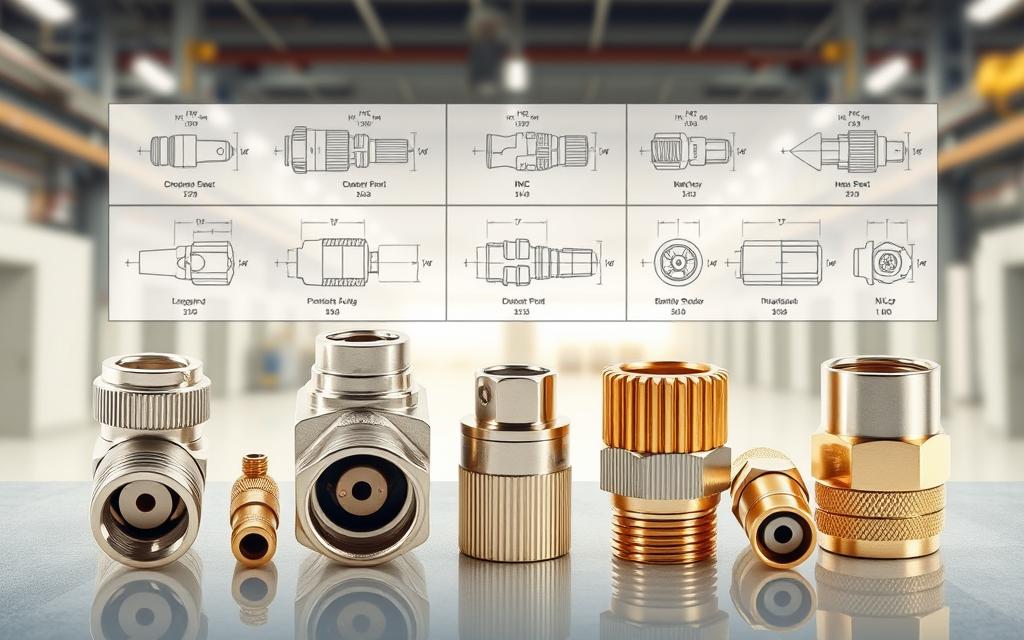
SMA versus N-Type Connectors
The sma vs n-type comparison shows two connectors for different needs. Both are good for RF, but they’re made for different uses.
Performance and Application Differences
N-Type connectors are great for high power and tough places. They can handle up to 2,700 watts at 1 GHz, perfect for broadcast and military use.
SMA connectors are smaller but better at high frequencies. They work well up to 18 GHz, while N-Type tops out at 11 GHz.
The size difference is big. N-Type is about 21mm, SMA is 9mm. SMA is better for tight spaces.
SMA versus BNC Connectors
The sma vs bnc comparison shows connectors with different ways to connect and frequency ranges. Each is good for certain areas.
Key Distinctions in Use and Design
BNC connectors have a bayonet-style for easy on and off. They’re great for test gear and video where you need to switch often.
SMA connectors have a threaded system for a tighter fit. They’re better at microwave frequencies, losing less signal and being more stable.
Frequency-wise, BNC is for up to 4 GHz, while SMA goes up to 18 GHz. SMA is better for today’s high-frequency systems.
| Feature | SMA Connector | N-Type Connector | BNC Connector |
|---|---|---|---|
| Maximum Frequency | 18 GHz | 11 GHz | 4 GHz |
| Coupling Mechanism | Threaded | Threaded | Bayonet |
| Typical Applications | Microwave, WiFi | Broadcast, Military | Video, Test Equipment |
| Power Handling | 500 watts at 1 GHz | 2,700 watts at 1 GHz | 300 watts at 1 GHz |
It’s also good to know the difference between SMA and SSMA for special needs. This ensures you pick the best connector for your project.
Each connector has its own role in RF. The right choice depends on your needs, frequency, and where it will be used.
Innovations and Future Directions for SMA Technology
The world of RF connectivity is changing fast, and SMA technology is leading the way. SMA connectors are getting better, with new features that boost their performance. This makes them key in today’s complex tech world.
Advances in Materials and Manufacturing
New materials are making SMA connectors better. Companies are using special alloys and composites. These material advances help them work at higher speeds with less signal loss.
Manufacturing has also improved a lot. New machines and systems make sure connectors meet high standards. This means SMA connectors can handle up to 40 GHz and work well in 5G and satellite tech.
Connectors are now more resistant to the environment. New plating methods keep them from corroding while keeping their electrical quality. This makes them reliable in tough places, from factories to outdoor phone masts.
Expanding Applications in IoT and 5G Networks
More devices are joining the Internet of Things, and SMA connectors are key. They’re used in smart homes, industrial sensors, and wearables. Their small size and reliable connection make them perfect for tight spaces in IoT applications.
5G networks are a big deal for SMA tech. They need connectors that work well at high frequencies. SMA connectors are essential in 5G base stations, small cells, and test gear.
Satellite tech also uses SMA connectors a lot. They’re great for their size and RF quality. This is helping low-earth orbit satellites and ground stations work better.
Test and measurement gear also depends on SMA connectors. As wireless tech gets better, so does the need for precise testing. SMA connectors ensure accurate signal transmission, helping to validate new tech and meet rules.
Conclusion
The SMA connector is small but strong, essential in technology for decades. It’s known for its top-notch high-frequency performance. This makes it key in RF systems and for antennas.
SMA is reliable and fits many uses, from old wireless tech to new 5G and IoT. It keeps connections stable, meeting tech’s changing needs.
As tech grows, so does the SMA connector. It uses new materials and methods. Its lasting importance shows it’s a reliable choice for smooth connections in our connected world.
FAQ
What does SMA stand for in technology connectors?
SMA stands for SubMiniature version A. It’s a type of coaxial RF connector. It’s widely used in antennas and high-frequency systems.
Who developed the SMA connector and when?
The SMA connector was developed in the 1960s. Engineers at Bendix Scintilla, which later became part of Amphenol, created it. They aimed to meet the needs of microwave technology for a compact and reliable connector.
What are the key components of an SMA connector?
An SMA connector has an outer shell, a centre contact or pin, and a dielectric insulator. The outer shell is usually brass or stainless steel. The centre contact is often brass or beryllium copper. The insulator is commonly PTFE, or Teflon®. Each part is chosen for its durability and performance.
What is the standard impedance for SMA connectors?
SMA connectors have a standard impedance of 50 Ohms. This is key for impedance matching in RF systems. It ensures efficient signal transmission.
What is the difference between standard SMA and RP-SMA connectors?
Standard SMA connectors have a centre pin and internal threads. RP-SMA connectors have a centre sleeve and are mechanically incompatible with standard SMA. RP-SMA was developed for regulatory compliance. It’s used by manufacturers like Netgear and Linksys on Wi-Fi equipment.
How do you identify SMA connector genders?
A Plug (Male) SMA connector has a centre pin and internal threads. A Jack (Female) has a centre sleeve and external threads. Correct mating is essential for a secure connection.
In which applications are SMA connectors commonly used?
SMA connectors are key in RF systems. They’re used in cellular base stations, microwave communication links, GPS modules, Wi-Fi routers, and satellite communication equipment. They’re also used in radio astronomy and medical devices that use RF signals.
What are the main benefits of using SMA connectors?
SMA connectors offer superior electrical performance. They have low Voltage Standing Wave Ratio (VSWR) and efficient power transfer. They have a robust mechanical design with threaded coupling. They’re durable, often rated for 500 mating cycles, and resistant to environmental factors.
What are the limitations of SMA connectors?
SMA connectors may be too large for modern devices. There are compatibility issues, like between standard SMA and RP-SMA. There's a risk of damage when mating high-precision variants with lower-grade connectors. Questions about sma mean connectors also connect with making life better worse when readers compare closely related topics. There's also confusion with incompatible connectors like the 75-ohm Type F used for television aerials.
How should SMA connectors be installed for optimal performance?
For optimal performance, use a torque wrench. Set it to 0.3–0.6 N·m for brass connectors. Avoid over-tightening and cross-threading, which can damage the connector.
What maintenance is recommended for SMA connectors?
Regular maintenance includes pre-mating inspection and cleaning interfaces with compressed air. This removes debris. Periodic checks ensure long-term reliability and consistent electrical performance.
How does SMA compare to N-Type connectors?
N-Type connectors are larger and handle higher power levels. They’re used in more rugged applications. SMA connectors are smaller and excel in high-frequency performance up to 18 GHz. They’re suitable for compact and high-frequency systems.
How does SMA differ from BNC connectors?
BNC connectors use a bayonet-style coupling for quick connect/disconnect. They're used for lower frequencies (up to 4 GHz) and are common in video and test equipment. SMA connectors, with their threaded coupling, offer better performance at microwave frequencies. Questions about sma mean connectors also connect with some tech categories when readers compare closely related topics. They're preferred in high-frequency RF applications.
What future trends are emerging for SMA technology?
Innovations include advances in materials science and manufacturing. These aim to enhance performance, durability, and precision. SMA connectors are also finding expanded applications in the Internet of Things (IoT) and 5G networks. Their reliability and high-frequency capabilities make them a continued choice.
Are SMA connectors suitable for 5G applications?
Yes, SMA connectors are well-suited for 5G applications. They offer high-frequency performance, reliability, and compatibility with antenna and RF subsystem connections. They’re a continued component of choice in evolving wireless technologies.